


A customer’s impression of a business begins long before a formal introduction. The appearance of employees, vehicles, premises and communications all contribute to how professional an organisation feels. Well-planned custom uniforms can help bring that identity together by giving staff a coordinated appearance that reflects the organisation they represent.
Customised staff clothing is useful across many industries. Retail teams, contractors, hospitality workers, tradespeople, corporate employees, event crews and service businesses can all benefit from clothing that makes employees easy to recognise. The key is to create something people are comfortable wearing rather than treating clothing as a moving advertisement.
Why Staff Presentation Matters
People naturally use visual cues when deciding whom to approach.
When employees wear coordinated clothing, customers can identify staff more quickly. This can be particularly helpful in busy stores, events, large facilities and service environments.
A consistent team appearance can also create a sense of organisation.
Employees arriving at a customer’s home, office or job site in coordinated branded clothing can present a more deliberate image than a team wearing unrelated personal garments.
Start With the Brand Identity
Before selecting garments, review your existing visual identity.
Consider:
-
Logo colours
-
Primary brand colours
-
Secondary colours
-
Existing signage
-
Vehicle graphics
-
Website design
-
Customer expectations
-
Industry positioning
Your staff clothing does not need to match every branding element exactly, but it should feel connected.
Avoid Using Too Many Colours
Simple combinations often look more professional.
For example, dark navy clothing with a small light-coloured logo can create a clean appearance. A brand with bright colours may use those shades as accents rather than making the entire garment bright.
The goal is recognition without visual overload.
Match Clothing to Employee Roles
Not every person in the organisation needs the same garment.
A company may employ salespeople, warehouse workers, technicians and managers. Trying to place everyone in identical clothing can result in garments that are inappropriate for certain tasks.
Instead, create a family of coordinated options.
For example:
-
Corporate shirts for management
-
Polos for customer-facing employees
-
Durable work shirts for technicians
-
T-shirts for warehouse teams
-
Jackets for outdoor employees
Keeping branding and core colours consistent can connect the different garments visually.
Prioritise Clothing Employees Will Actually Wear
A successful branded wardrobe must be comfortable.
Employees wearing a garment for a full shift will notice problems such as poor fit, scratchy fabric or limited movement very quickly.
Before placing a large order, think about:
-
Fabric feel
-
Breathability
-
Seasonal conditions
-
Garment weight
-
Size availability
-
Cut and fit
-
Washing requirements
Getting employee feedback can be particularly valuable if you are changing an established uniform.
Use Trusted Garment Ranges
Businesses looking for practical staff apparel can review ranges such as Jb’s Wear when comparing polos, shirts, tees, jackets and other team clothing.
Using an established range can help businesses create consistency across multiple garment types without having every employee wear exactly the same piece.
Think in Terms of a Wardrobe
Instead of ordering one branded shirt, build a small system.
A typical employee allocation might include:
-
Several everyday tops
-
One warmer layer
-
One jacket where required
-
Appropriate trousers or shorts
-
Role-specific clothing if needed
This approach helps staff stay coordinated across different weather conditions.
Choose the Right Branding Method
Different decoration methods can create different visual effects.
Embroidery often suits polos, shirts, jackets and corporate garments because it can produce a structured, professional appearance.
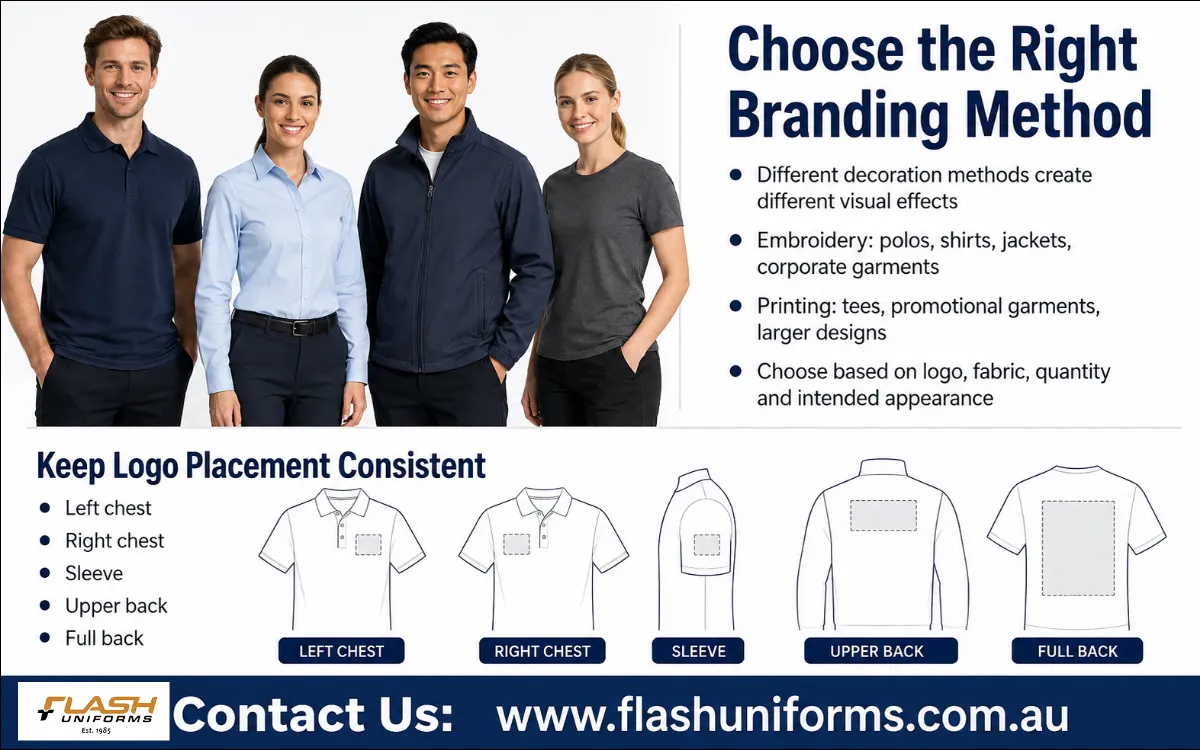
Printing can work well on tees, promotional garments and larger designs.
The appropriate method depends on the logo, fabric, quantity and intended appearance.
Keep Logo Placement Consistent
Choose a standard position and use it across most garments.
Common locations include:
-
Left chest
-
Right chest
-
Sleeve
-
Upper back
-
Full back
The left chest is popular for understated business branding, while larger back designs can be useful when employees need to be identified from a distance.
Think About Customer-Facing Situations
Consider where customers see your employees.
A receptionist may need clothing that complements the office environment. A technician entering homes may need something clean and professional but durable enough for practical work.
Event staff may benefit from garments that make them instantly recognisable in a crowd.
The right clothing should support the context in which employees interact with customers.
Use Different Garments Without Losing Consistency
Variation does not have to weaken the brand.
Employees can have some choice while staying within an approved framework.
For example, you might allow a polo or button-up shirt in the same colour, or offer both short- and long-sleeve versions.
This flexibility can improve employee comfort while keeping the overall appearance coordinated.
Consider New Employee Onboarding
Uniforms are part of the employee experience.
Having clothing ready for a new team member’s first days can make onboarding feel more organised.
Develop a standard allocation for each role so managers know exactly what to order.
Record information such as:
-
Approved product
-
Colour
-
Logo position
-
Decoration method
-
Employee size
-
Quantity issued
This simplifies future reorders.
Care and Maintenance Affect Presentation
Even good-quality garments will look poor if they are not maintained correctly.
Provide employees with basic care information based on garment instructions.
Encourage staff to report items that become damaged, faded or no longer fit appropriately.
Regular replacement helps prevent a situation where some employees are wearing fresh clothing while others are still using heavily worn garments.
Think About Long-Term Availability
When building a major uniform program, continuity matters.
Constantly changing garment styles can result in teams wearing noticeably different clothing.
Choosing versatile, established styles may help make future replacement ordering easier.
Businesses should also keep their branding artwork and decoration specifications organised so logos remain consistent across orders.
Why Choose Flash Uniforms?
Flash Uniforms brings together workplace apparel, corporate clothing, casual team garments and custom branding solutions for Australian organisations. Businesses can explore multiple recognised clothing ranges and select items appropriate for different employee roles while maintaining consistent branding. This flexibility is useful for organisations building a new staff wardrobe or updating an existing uniform program without having to rely on one garment style for every employee.
Final Thoughts
Branded staff clothing can help create a stronger, more professional business presentation when it is planned thoughtfully.
Start with the company’s visual identity, understand employee roles and select garments people can comfortably wear throughout their working day.
Keep colours and logo placement consistent while allowing enough flexibility for different roles, seasons and preferences.
The result should not feel like promotional merchandise. It should feel like practical everyday clothing that happens to represent the business clearly and professionally.
When custom uniforms achieve that balance, they can become a natural extension of the brand every time an employee interacts with a customer.